
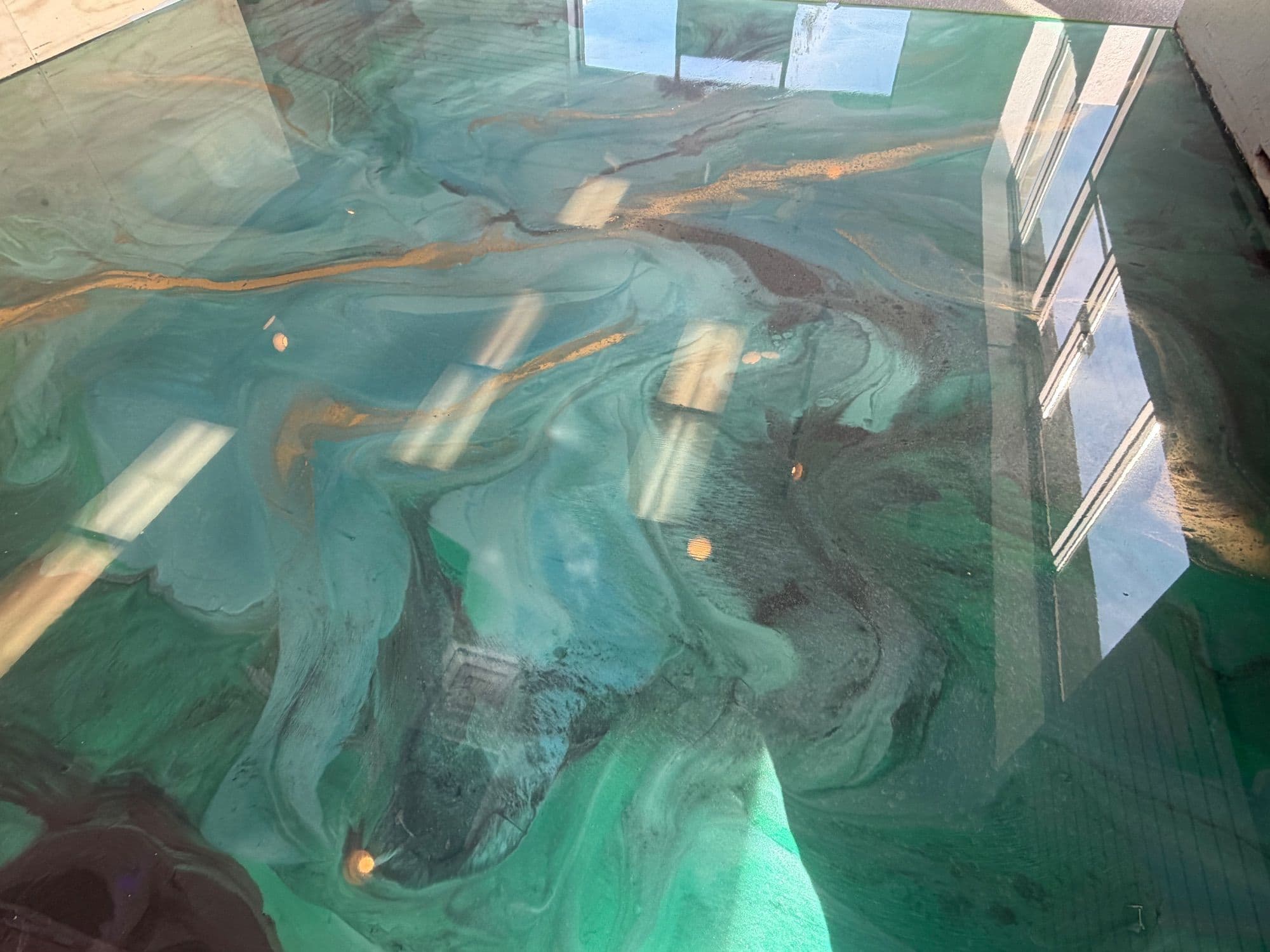
You have a shop, pole barn, dealership, or commercial floor in the Des Moines metro. You want to protect it, make it easier to clean, and maybe make it look professional. Someone told you to seal it. Someone else said to coat it with epoxy. You are not sure which one is worth the money.
Here is the short answer: concrete sealer is a surface treatment that soaks in or sits on top of bare concrete. A floor coating system is a structural build-up of 20 or more mils of coating bonded to the slab. For most working shops, dealerships, warehouses, and pole barns in Des Moines, a full coating system will outlast and outperform sealer by years. Sealer is not a bad product. It is just the wrong tool for floors that carry forklifts, vehicles, chemicals, and heavy foot traffic.
This article walks through both options with real numbers so you can decide what makes sense for your facility.
What Concrete Sealing Actually Does
Sealers fall into two categories.
Penetrating sealers (silane, siloxane, lithium silicate densifiers) soak into the concrete and react with the pore structure. They reduce dusting and slow moisture absorption. They do not change the appearance much and add almost no build-up above the surface. They are measured in microns, not mils.
Topical sealers (acrylic, polyurethane, epoxy-blend) sit on top of the slab and form a thin film, usually 2 to 5 mils thick. They add some gloss and limited stain resistance. They are what most hardware stores sell in five-gallon buckets.
Both types have real uses. Penetrating sealers are good for outdoor concrete, driveways, or tilt-up walls where you need moisture protection without a film. Topical sealers work on low-traffic decorative concrete, covered patios, or seasonal spaces.
What they are not built for: vehicle traffic, oil drips, forklift tires, road salt tracked in from Iowa winters, chemical spills, or daily power washing. In those environments, a thin sealer film wears through fast.
What a Full Floor Coating System Does
A professionally installed floor coating is a layered system bonded to the concrete itself. At Colin Coatings we follow the Iowa Floor Coating Standard, which means every floor gets:
- Diamond grinding to CSP 2-3 profile (the coating grips the slab mechanically)
- A calcium chloride or RH moisture test before any product goes down
- Crack and joint repair with polyurea filler
- A 100% solids epoxy base coat at 10 to 15 mils
- A broadcast layer of flake or an intermediate coat if the design calls for it
- A UV-stable polyaspartic topcoat at 4 to 6 mils
- Total system thickness: 20 mils minimum for shops, 30+ mils for heavy commercial and industrial
That build-up is what gives a coated floor its durability. It is not just protection sitting on top of the slab. It becomes part of the surface structure.
For the right applications, epoxy flooring is one of the hardest, most chemical-resistant surfaces you can install on a concrete floor. Paired with a polyaspartic topcoat, it resists yellowing and handles Iowa's freeze-thaw cycles and road salt without degrading.
Side-by-Side: Sealer vs Coating for Commercial and Shop Floors
Here is a direct comparison across the factors that matter most for working facilities in Des Moines.
Durability Under Real Traffic
A topical sealer on a shop floor will start showing wear in high-traffic lanes within one to three years under moderate vehicle and foot traffic. In a busy dealership service bay or a pole barn used year-round, that timeline is shorter. Peeling, scuffing, and tire marks are common.
A properly installed 20-mil coating system routinely lasts 10 to 15 years under the same conditions. Our written 5-year workmanship warranty covers delamination and peeling. The floor is expected to far outlast that warranty period with basic maintenance.
Chemical and Oil Resistance
Most topical sealers are not rated for prolonged contact with petroleum products, transmission fluid, battery acid, or the chloride-loaded slush that gets tracked into Iowa shops every winter. They absorb staining and soften under those chemicals.
High-build epoxy with a polyaspartic topcoat is rated for chemical resistance across a broad spectrum. Fluid drips wipe up. Road salt does not etch the surface. Battery acid from forklifts does not penetrate.
Prep Requirements
This is where people sometimes make the wrong call. A good penetrating sealer requires clean, open concrete pores. A good topical sealer needs the surface clean and lightly etched. Neither requires diamond grinding.
A floor coating system requires diamond grinding to CSP 2-3. That is not optional. Without mechanical profile, the coating does not bond and will peel. If a contractor quotes you a coating without diamond grinding, walk away.
Prep is more involved for coatings, and it adds to the cost. But it is also why coatings last and sealers on unprepped slabs do not.
Cost
This is where sealer looks attractive on paper.
Penetrating sealer applied professionally: roughly $0.30 to $0.80 per square foot for most commercial applications in Iowa.
Topical sealer applied professionally: roughly $0.75 to $1.50 per square foot depending on the product and prep needed.
Professional 20-mil flake floor coating system: roughly $4 to $7 per square foot for a shop or pole barn in the Des Moines area. Large commercial projects with simple layouts can come in lower per square foot.
Heavy commercial or industrial 30-mil systems: roughly $6 to $10 per square foot depending on substrate condition, square footage, and chemical resistance requirements.
The math changes when you factor in replacement cycles. A sealer that reapplied every two to four years at $1.50 per square foot adds up. A coating that lasts 10 to 15 years at $5 per square foot is often the better total cost of ownership, especially on floors over 3,000 square feet where durability matters more.
Appearance and Professionalism
For dealerships, auto body shops, retail stores, medical facilities, and commercial spaces that clients walk into, appearance matters. A sealed floor looks like a sealed floor. A full flake or solid-color coating system looks like a finished professional space.
Many of the shops and dealerships we coat in areas like Ankeny, Altoona, and West Des Moines are customer-facing. The coating is part of the brand. Flake floor systems in particular hide minor surface texture and small imperfections while giving you a clean, uniform look that holds up to daily mopping.
Turnaround Time
Penetrating sealers cure fast. Most are ready for light traffic in 24 hours. Topical sealers vary, but most are walkable in 4 to 8 hours and ready for vehicle traffic in 24 to 48 hours.
A polyaspartic-based floor coating system, which is what we install, is ready for foot traffic in 4 to 6 hours and full vehicle traffic in 24 hours. Most shops are back in operation the next morning. That turnaround is comparable to sealer and far faster than old-school epoxy-only systems that needed 5 to 7 days.
When Sealer Is the Right Answer
Sealer is not always the wrong choice. Here are situations where it makes sense:
- Outdoor exposed concrete like aprons, lot paving, or loading docks where a topcoat would degrade from UV and moisture cycling (use penetrating siloxane)
- New concrete that needs to cure more before coating (a temporary densifier buys time)
- Very large low-traffic storage areas where appearance is not a priority and the budget is tight
- Driveways and exterior flatwork that are not coatable in their current condition
If your floor falls into one of those categories, sealer may be the practical choice right now. We will tell you that honestly.
When a Full Coating System Is the Right Answer
For most working commercial facilities in the Des Moines metro, a full coating system is the right call. Specifically:
- Auto dealerships and service bays: oil, coolant, road salt, customer traffic
- Auto body shops and collision centers: chemicals, solvents, heavy equipment
- Pole barns and ag shops: year-round use, equipment, moisture from Iowa winters
- Retail showrooms and warehouses: appearance, cleanability, forklift traffic
- Machine shops and fabrication facilities: coolant, metal chips, hard rolling loads
- Fitness centers and gyms: moisture, rubber, cleaning chemicals
- Medical and dental clinics: hygiene, seamless surface, frequent chemical cleaning
For commercial and industrial facilities, we routinely install 30-mil systems with thicker epoxy bases and broadcast media for texture and slip resistance. The system is engineered around what the floor actually does.
For shop and pole barn floors outside the city, like facilities in Grimes, Bondurant, or Adel, the conditions are often harder on floors than urban shops because of greater temperature swings and more equipment movement. Those floors benefit the most from a properly installed coating system rather than a sealer that needs replacing every few years.
You can also see examples of completed shop and warehouse floors to get a sense of what the finished product looks like across different facility types.
Moisture: The Variable That Changes Everything
One factor that affects both sealers and coatings is concrete moisture. Iowa slabs, especially older ones without a proper vapor barrier, can push significant moisture vapor through the concrete. On a warm summer day in Des Moines, a slab sitting on ground can emit 10 to 15 pounds of moisture vapor per 1,000 square feet per 24 hours.
Topical sealers on high-moisture slabs will bubble and peel. Floor coatings on untested slabs will delaminate. The fix is the same either way: test first.
We run a calcium chloride test or an in-slab RH test on every floor before we quote the system. Some slabs need a vapor-tolerant primer before the base coat. Some rare slabs are too wet for any coating and only a penetrating sealer or a mechanical fix makes sense. Knowing which situation you have before you spend money is the whole point of proper prep.
What to Do Next
If you are managing a shop, dealership, warehouse, pole barn, or commercial facility in the Des Moines area and you want a straight answer about which system your floor actually needs, we can walk the space and give you an honest assessment. No pressure to coat if sealer is the right call, and no oversell on a coating system your floor does not need.
Request a free estimate and we will schedule a site visit, run a moisture test, look at the slab condition, and give you a written quote for whatever system makes sense for your operation.