
The Iowa Floor Coating Standard · By Jose Colin, Colin Coatings Des Moines
Why Garage Floor Coatings Peel in Iowa — and the 7 Points That Stop It
Most floor coatings in Iowa fail in 2 to 3 years. Not because the products are bad, but because they were installed like a paint job in a climate that punishes paint jobs. Des Moines garages see more than 100 freeze-thaw cycles a year, magnesium-chloride road salt all winter, moisture vapor pushing up from saturated clay every spring, and tire temperatures over 140°F in July.
After 20+ years pouring concrete across Central Iowa and years of being called to fix other people's coatings, I wrote down the seven things that separate a floor that lasts 20 years from one that peels in two. Use it to check any bid, including ours.
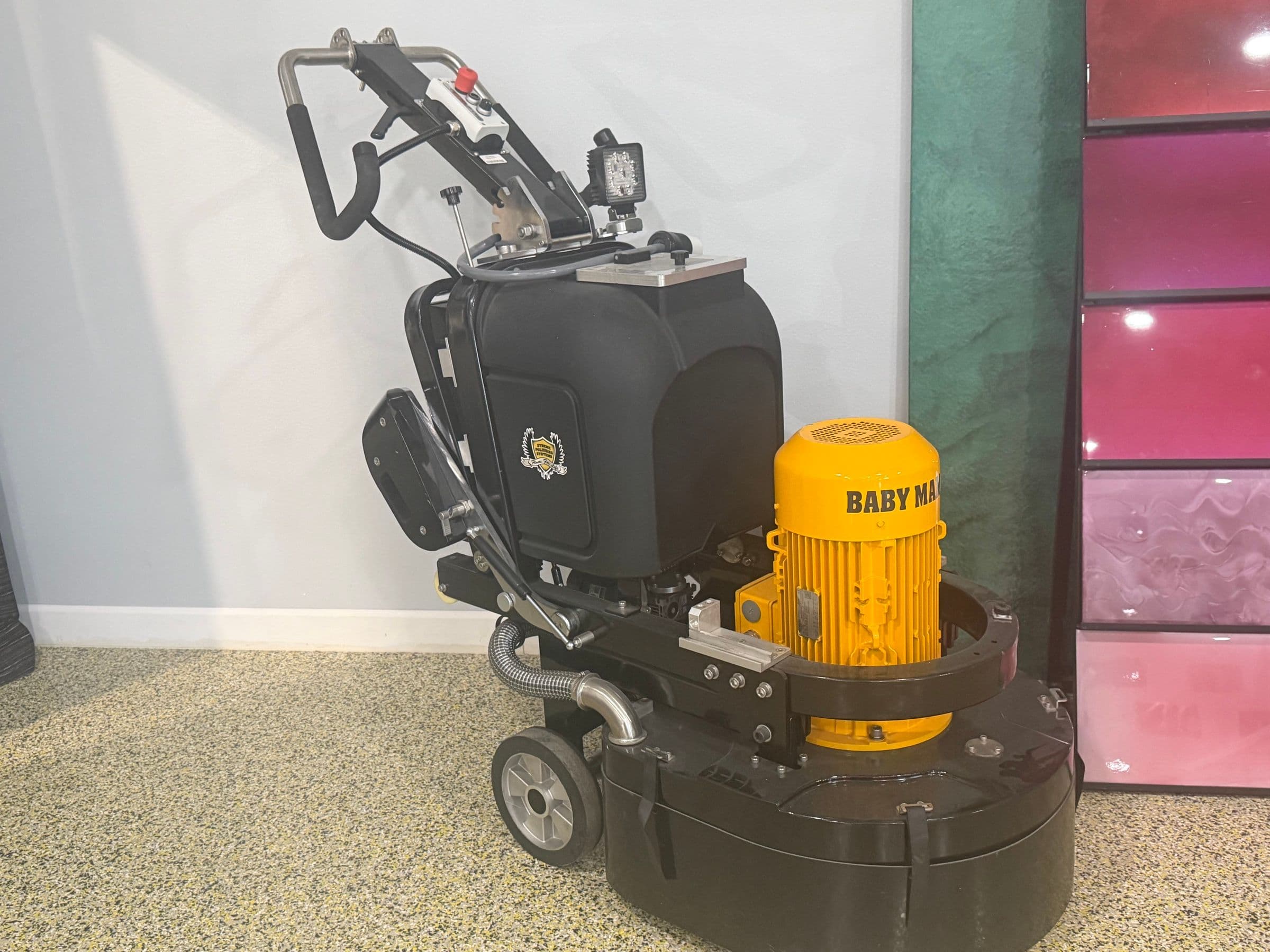
01 — Diamond Grinding, Not Acid Etching
The standardThe entire slab is mechanically ground with diamond tooling to a concrete surface profile of CSP 2–3, with dust collection.
Why it mattersAcid etching dissolves a little surface paste and leaves laitance and dust behind. A coating bonded to dust peels when the dust lets go. Grinding removes laitance, opens the pores, and gives the coating a mechanical grip on sound concrete. It's louder, slower, and more expensive, and it's the single biggest predictor of whether a floor stays down.
Ask the bidder"Do you diamond-grind or acid-etch?" Anything but "grind, every floor" is a fail.
02 — Moisture Vapor Testing
The standardA calcium-chloride test (ASTM F1869) or in-slab relative-humidity test (ASTM F2170) on every floor, before the quote is final, with results in writing.
Why it mattersIowa slabs sit on saturated clay. Vapor moving up through the concrete gets trapped under a coating and lifts it in blisters, sometimes within weeks. Basements and new-construction slabs in Waukee, Grimes, Ankeny, and Bondurant are the worst offenders. If the numbers are high, the fix is a moisture-mitigating primer, not hope.
Ask"What was my moisture reading?" If there wasn't one, the floor wasn't tested.
03 — Crack and Joint Repair First
The standardCracks chased and filled with polyurea or epoxy, pits and spalls patched, control joints filled with semi-rigid polyurea, everything ground flush before the first coat.
Why it mattersA coating is thin. It can't bridge a moving crack or fill a salt pit. Unrepaired damage telegraphs through and becomes the first place the coating fails.
Ask"Is repair a line item?" It should be, even if the amount is small.
04 — Minimum Dry-Film Thickness
The standard20+ mils total dry film for residential flake systems; 30+ mils for commercial; 1/8" to 1/4" for industrial and urethane cement.
Why it mattersA hardware-store kit is 3 to 4 mils, about the thickness of a trash bag. Hot tires and salt go through it in one season. Thickness is what buys abrasion resistance and the ability to hide repairs.
Ask"What's the total system thickness in mils?" A real contractor answers instantly.
05 — UV-Stable Topcoat
The standardA polyaspartic or aliphatic urethane topcoat on any floor that sees sunlight, which is every garage.
Why it mattersEpoxy left bare in direct sun will slowly amber and chalk; sun through a garage door does it in a few summers. A polyaspartic or aliphatic urethane topcoat over the epoxy base solves it completely, adds hot-tire and chemical resistance, and cures fast. That hybrid is the standard garage floor we install. → Polyaspartic vs. epoxy
Ask"What's the topcoat?" On a sunny garage the answer should be polyaspartic or aliphatic urethane, not a bare epoxy top.
06 — Temperature and Humidity Window
The standardSlab temperature at least 5°F above the dew point, air and slab within the product's stated range, documented on install day.
Why it mattersCoatings applied to a cold or damp slab don't cure right and don't bond. Unheated Iowa garages fall below standard epoxy's 50–55°F minimum for five months a year. Cold-cure epoxies and polyaspartic extend the season; heaters and dehumidification cover the rest. The contractor should know the numbers on the day.
Ask"What temperature range does this product cure in, and how do you handle a January install?"
07 — Written Warranty and Documentation
The standardProduct names and data sheets, batch numbers, thickness readings, photos of each stage, and a written workmanship warranty that names peeling, delamination, and hot-tire pickup.
Why it matters"Lifetime warranty" from a company with no address means nothing. Documentation means the contractor can prove what they installed, and the warranty means they'll be back if they're wrong.
Ask"Can I get the warranty and the product data sheets in writing before I sign?"
The Bid Comparison Scorecard
Score each bid 0–7. One point per standard the bidder meets, in writing.
| # | Standard | Bid A | Bid B | Bid C |
|---|---|---|---|---|
| 1 | Diamond grinding, every floor | |||
| 2 | Moisture test, results in writing | |||
| 3 | Crack/joint repair as a line item | |||
| 4 | Total thickness stated in mils (20+ residential) | |||
| 5 | Polyaspartic or aliphatic urethane topcoat | |||
| 6 | Temperature/dew-point plan for install day | |||
| 7 | Written warranty + product data sheets | |||
| Total (out of 7) |
A 7 is a floor that will last. A 5 is negotiable. Anything under 4 is a repaint in three years.
Frequently Asked
Why did my epoxy garage floor peel?
Is a one-day floor coating a gimmick?
How do I compare garage floor coating quotes?
Does this standard apply to basements and commercial floors?
About the author
Jose Colinis the owner of Colin Coatings Des Moines and Colin Concrete Des Moines. He has poured, finished, repaired, and coated concrete across Central Iowa for more than 20 years. [Link to About page. Add photo.]
Colin Coatings Des Moines installs floor coatings to this standard on every job in Des Moines, West Des Moines, Ankeny, Urbandale, Waukee, Johnston, Clive, Altoona, Grimes, Bondurant, Pleasant Hill, Norwalk, Polk City, Windsor Heights, Indianola, Adel, Van Meter, Booneville, and Prairie City. Call (515) 800-9393 or visit colincoatingsdesmoines.com.
THE IOWA FLOOR COATING STANDARD — BID CHECKLISTColin Coatings Des Moines · (515) 800-9393 · colincoatingsdesmoines.com
Before you sign a floor coating contract in Iowa, get a written "yes" on each:
☐ 1. The entire floor will be diamond-ground (not acid-etched). ☐ 2. A moisture test will be done and the reading given to me. ☐ 3. Crack, pit, and joint repair is a line item. ☐ 4. Total system thickness is 20+ mils (residential) / 30+ mils (commercial). ☐ 5. The topcoat is polyaspartic or aliphatic urethane (UV-stable). ☐ 6. The installer has a temperature/dew-point plan for install day. ☐ 7. I will receive a written warranty and product data sheets before signing.
Score: ___ / 7. Fewer than 5? Get another bid.
Ready for a floor you can hose off?
Free on-site estimate anywhere in the Des Moines metro. Most garages done in one day.